Q&A: What you need to know about Afghanistan after five years of Taliban rule
Five years after the Taliban’s return to power, Afghanistan remains one of the world’s largest humanitarian crises. While levels of active conflict have decreased in many parts of the country, allowing people to travel to medical facilities, millions continue to face significant challenges in meeting their needs, including access to healthcare, food, clean water, and livelihoods. These needs are driven by a combination of deeply interconnected factors, including the legacy of decades of conflict and chronic underinvestment in essential services.

What is MSF doing in Afghanistan?
MSF has worked in Afghanistan since 1980, and continues to witness the immense humanitarian and healthcare needs facing the population. While active conflict has decreased in many parts of the country and travel to health facilities is safer in some areas, millions of people still struggle to access essential healthcare, food, clean water and sustainable livelihoods.
MSF runs eight projects in eight provinces, with a particular focus on secondary healthcare, including paediatric and maternal care. Across our projects, we see a healthcare system that is overstretched, under-resourced, and increasingly unable to meet the needs of the population.

What is the humanitarian situation, five years after the Taliban’s return to power?
Today, humanitarian needs are driven less by active conflict and more by widespread poverty, economic fragility, recurrent natural disasters, and the disrupted healthcare system. Many families struggle to afford healthcare costs or transportation to health facilities, while vulnerable groups, including women, children, displaced people and those living in remote areas, continue to face additional barriers to accessing care.
What situations are women and girls facing?
Since August 2021, the Islamic Emirate of Afghanistan (IEA) has issued more than 470 decrees, of which 79 specifically target women and girls, restricting their freedom of movement and their participation in education, employment, the economy and public life. (OCHA).
Increased restrictions placed on their freedom of movement (e.g. mandatory chaperone), access to education (ban from secondary and tertiary level since 2021), and even the right to work for non-governmental organisations (e.g. Afghan women banned from working for UN entities in 2023).
Excluding women from medical institutes threatens the future of healthcare in Afghanistan, especially when in women-only clinical spaces, for example maternity and reproductive health services. These constraints will further restrict access to quality healthcare and pose serious risks to its availability in the long term.
How have increased restrictions on women affected access to healthcare?
MSF is concerned that restrictions on women’s education are undermining the long-term sustainability of Afghanistan’s female health workforce, with significant implications for maternal care in a country that continues to have one of the world’s highest maternal mortality rates.
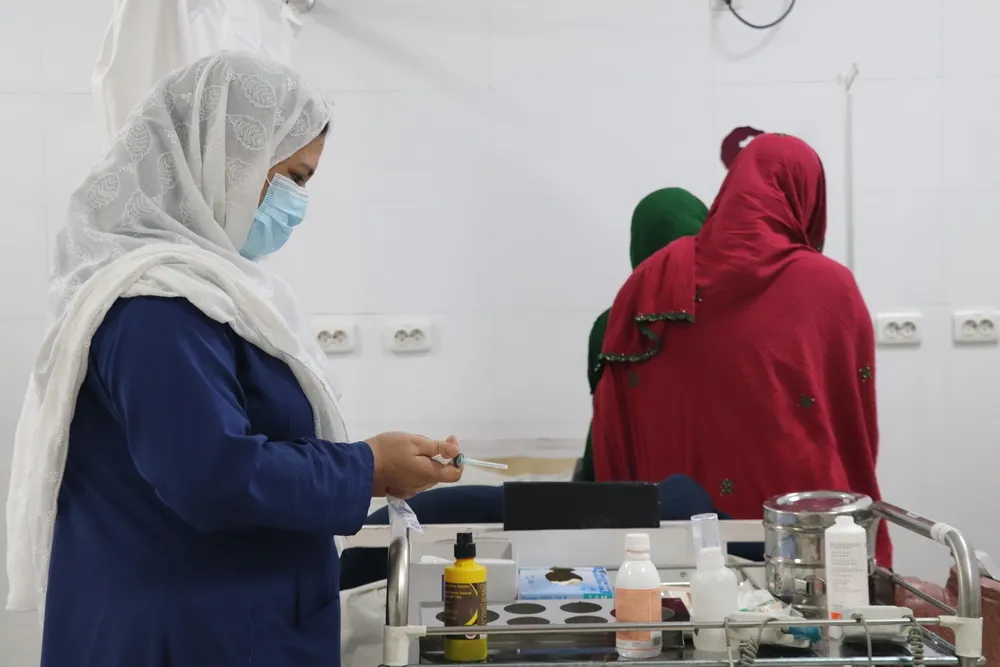
Female staff remain central to MSF’s work in Afghanistan. MSF currently runs eight projects across eight provinces, delivering maternity, pediatric, trauma and tuberculosis care. Women make up 45 per cent of MSF nurses in the country overall; in maternity-focused projects they represent more than half of the workforce and are essential to providing care in women-only clinical spaces.
The sustainability of healthcare services, particularly maternal care, relies on the continued training, licensing and retention of female health workers.
Is Afghanistan a forgotten crisis?
With new crises emerging around the world, Afghanistan often receives less media coverage than it once did, even though humanitarian needs remain immense and continue to affect millions of people.
Many people continue to face significant barriers to timely, quality medical care. The people most affected are often those with the fewest resources - families living in rural and underserved areas, who already face difficulties reaching healthcare facilities. Their needs have not disappeared simply because international attention has moved elsewhere.
What is the current health situation in Afghanistan?
Afghanistan’s health system remains under severe strain and is struggling to meet the country’s immense health needs. The system is chronically overburdened, under-resourced, and heavily dependent on international funding and out-of-pocket payments from patients and their families.
Since 2025, international funding for the health sector in Afghanistan has reduced significantly, leading to the closure or suspension of activities in 445 health facilities across the country in 2025 alone and an addition of more than 150 health centres during the first half of 2026. As a result, access to healthcare services, particularly primary healthcare at the community level, has been severely affected.

What are the main health issues in Afghanistan?
- Food insecurity and malnutrition: an issue that needs to be addressed from pregnancy to infancy; not only children but caregivers also struggle to find food for the household. Malnutrition increases susceptibility to infections such as pneumonia, diarrhoea disease, measles and tuberculosis, while these illnesses further worsen a child's nutritional status. This frequently leads to rapid deterioration and hospitalisation.
- Maternal mortality: Afghanistan ranks one of the world’s highest maternal mortality rates, with approximately 620 maternal deaths per 100,000 live births. This is due to: a lack of antenatal and post-natal care which may leave complications unnoticed; unsafe delivery especially in rural areas where home deliveries remain; delayed treatment; short birth spacing; and the women’s education ban leading to a shortage in female health workers - particularly affecting maternal care.
- Natural disasters including earthquakes, droughts, and flooding.
What were some of MSF’s key activity highlights from 2025?
- 417,395 Emergency Room consultations
- 53,971 deliveries with 3,213 caesarean sections conducted
- 31,620 measles patients treated
- 9,388 Inpatient Therapeutic Feeding Centre admissions, and 3,166 patients enrolled in outpatient feeding programs
- 124 drug-resistant tuberculosis patients enrolled in treatment

What is the situation for people who are forced to return to Afghanistan?
Between 2023 and 2026, roughly six million Afghans returned from Iran and Pakistan, straining Afghanistan’s fragile healthcare system. The systematic erasure of women and girls from public life, sweeping US aid cuts and wider funding declines, an overstretched health system and a deepening economic crisis compound the challenges returnees face to reintegrate.
MSF assessments of informal returnee settlements in Afghanistan’s Kandahar province in October 2025 and April 2026 found a lack of basic healthcare, inadequate shelter, undernutrition, and poor sanitation - increasing outbreak risk.
MSF urges countries hosting Afghan refugees to halt all involuntary returns to Afghanistan and ensure return processes do not undermine the protection and safety of refugees.