
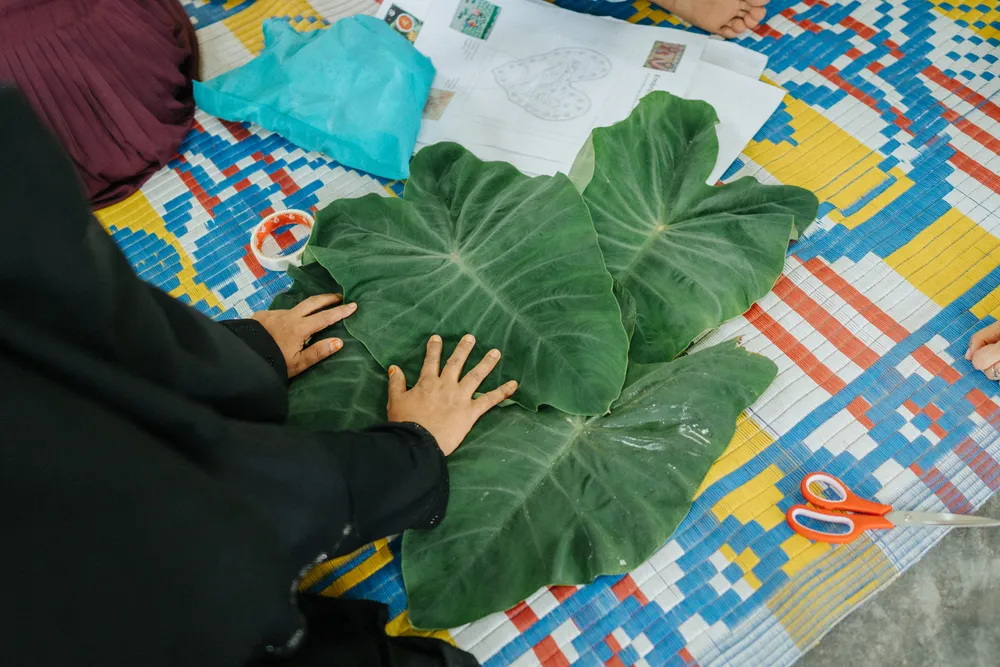
Ten Rohingya artists, 10 children, and the confines of Kutupalong refugee camp. Together they developed a symbol that tells the story of Rohingya statelessness in a new way.
A joint campaign by the Creative Advocacy Partnership (CAP) and Médecins Sans Frontières / Doctors Without Borders (MSF), this advocacy project builds on four years of collaboration with Rohingya communities Sydney, Malaysia and Bangladesh.
A journey of statelessness
Eight years after over 800,000 Rohingya fled violence in neighbouring Myanmar, more than 1.2 million people remain in limbo in Cox’s Bazar, Bangladesh, and confined to camps. This includes more than 150,000 Rohingya who arrived since January 2024, after renewed clashes between armed groups in Myanmar. They are almost completely dependent on dwindling humanitarian assistance in Bangladesh, including food, and prohibited from formal employment. Generations of children have no recognised education. Meanwhile, the living conditions in the camps are deteriorating, with unexplained fevers, hepatitis C outbreaks, and scarcity of food and water. Most importantly, those in the camps face a future without hope for a life beyond their current confines.
Despite decades of persecution, their plight has little mainstream visibility. Rohingya people are often reduced to static narratives—refugee, stateless, victim—undermining long-term advocacy. The Rohingya have also been subjected to vicious misinformation, and campaigns of dehumanisation. Described by the United Nations as one of the most persecuted minorities in world and having faced decades of persecution, the Rohingya express facing a loss of their culture and identity as a people.
The taro leaf as a symbol
The taro leaf symbol has become a symbol of existence for the Rohingya, which is their resistance. The leaf, and its accompanying proverb—‘We are like water on a taro leaf’—is a powerful metaphor for the Rohingya experience of statelessness. It reflects the feeling of floating, of having no land underfoot, belonging nowhere, and of being caught between countries that do not want them.
This is a testament to creative resistance and an expression of solidarity to tell a story of home woven through a rich tapestry of cultural traditions. These are not a stateless people. These are a people who demand a return to their homes in Rakhine state, with dignity and hope for the future.
The word 'statelessness' is a political label that has been imposed on the Rohingya. Although it plays a role in advocacy, it is also a term that is derogatory and brings shame for the community. Over time, the world has become desensitised to a word that describes one of humanity’s largest failings.
The taro leaf aims to reintroduce this story in a different way, in community language, and through a symbol that speaks more to the experience and feeling of statelessness.
“The word stateless has been put on us; we are not stateless, we have a state, but we were pushed off that state. In Rohingya, statelessness is ‘basha’, a dirty word meaning you are floating, you have nothing, no roots anywhere. I'd rather say I am Rohingya, Indigenous to Myanmar." - Ruhul
The symbol of the taro leaf first emerged while co-designing the Meeras Pavilion with Rohingya in Sydney, Malaysia and Kutupalong. During a community conversation one man used Hoñsu Fathar Faaní to describe the feeling of statelessness. The taro leaf grew from these discussions into a powerful tool that could help to build solidarity amongst advocates and allies.
“We have nothing fancy to give. We don't have watermelon emojis, a loud community or fancy shirts to offer; most of our community members are rebuilding their lives post-resettlement.” - Noor Aziah
The taro leaf is growing as an international symbol in Rohingya advocacy, the Creative Advocacy Partnership, supported by MSF Australia, is supporting development of the symbol through storytelling and creative projects.

The artists behind the art
Poetry: Asma Nayim Ullah is a Rohingya poet, youth advocate and co-founder of ARWDO, and co-lead for the Creative Advocacy Partnership. They wrote and recorded a beautiful poem about the Taro Leaf, that wove community voices together and spoke directly to the kids in the camp, urging them to “play, draw, sing, exist, because you, Futu, you are the proof we were always here."
Illustration and animation: Asma’s poem was first illustrated by a group of Rohingya children, and then Faroque, an incredibly talented 18 year old artist spent the two weeks refining the drawings, filing in gaps, and creating the main backgrounds. He taught himself to draw as a child after being inspired by movie sign painter at the local shops in Myanmar.
Bamboo and fish net weaving: Nurul Islam created a Taro leaf using the cane glass method while also merging traditional thatching and a frame made from colourful nylon cord. Nuru Sabar made her own Taro Leaf, showing her skills of fish net weaving. This practice was part of daily life in Myanmar. Coming from a farming and fishing family, she saw this skill being lost in the camp without land to farm or waterways to fish, and has been running weaving workshops for women to help retain this practice.
Woodworking: Kolim, a woodworker from Maungdaw, learnt the age of 10 from a local craftsman. “We started this work out of necessity, to put food on the table, now I make furniture for weddings, and baby cradles," he says. For the Symbols Project, he shaped a Taro Leaf from eucalyptus, carving perfect curves entirely with hand tools.
Embroidery: Senu Anara is an embroiderer known for making pillowcases, dresses, and lungis. Embroidery holds deep meaning in the camp, as each piece carries stories and cultural memory in a form of quiet resistance. “We never thought the Rakhine or Burmese governments would drive us away," she says. "The taro leaf is our document. Like water, we’ve been forced to flow elsewhere... if we show this to the world, maybe our mark will remain.”
Ceramicists: Kali and Beshi Bala collaborated to create a Taro leaf made from 66 tessellating tiles. Bala’s hands worked with precision, drawing on her experience making pots and water vessels. Kali was more involved in the design, and while making was always singing and laughing, bringing light to group. Both are from the Hindu minority and have only been in Kutupalong for a few months, fleeing after recent attacks.
Photographers: Zia Hero is a renowned photographer and co-founder of Rohingya Photographer Magazine, a collective of visual storytellers capturing the humanity and daily life in the camp whose publications have played a vital role in shifting public narratives about the Rohingya. Zia also partnered with MSF photographer Victor Caringal to create a photo essay walking through the camps.
Chef: Rayhana Begum prepared 20 delicious Rohingya dishes, which were beautifully displayed on a banana leaf cut into the shape of the Taro symbol, with design help by Mohamed Yakub. Rayhana first learned to cook from her mother and sisters, and later received formal training. For Rayhana, cooking is about care and preserving cultural identity.
Storyteller: Mohammed Yakub Yakub is a storyteller who developed a Kyssa (folk story) about a Taro leaf who dreams to hold the sky’s sorrow—a moving piece that took the proverb into new places.


What is creative advocacy?
MSF has partnered with the Creative Advocacy Partnership (CAP), a group of Australian advocates, artists and designers who use creative practice to influence positive change. CAP partners with communities to make things together, including artworks, installations, events, audio stories, poems, talks or performances, and through these projects aims to connect people together, shift oppressive narratives and strengthen the way communities are advocating for change.
MSF and CAP partnered in 2023 to produce Two Crows: Creative advocacy in the Kutupalong refugee camp, Bangladesh where artists from Australia collaborated with Rohingya storytellers, families and bamboo weavers to produce a kyssa (folktale) of two crows, one from the city and one from the country, who meet in a banyan tree and learn the value of cleverness and unity in difficult times.

