Snakebite
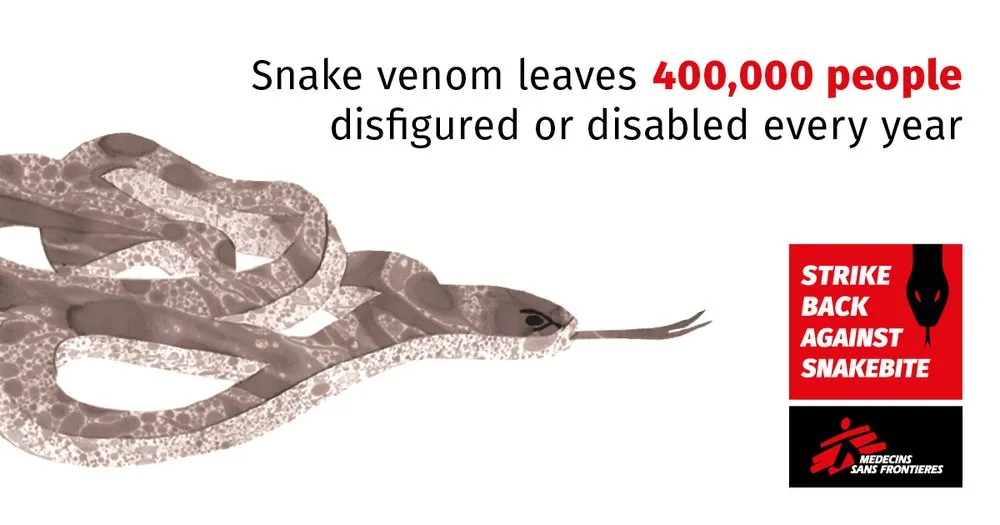
An estimated 2.7 million people are bitten by venomous snakes worldwide every year, resulting in death for more than 100,000 people and life-long disfigurement and disability for 400,000 more.
Although effective treatment exists for snakebite envenoming (poisoning from snakebites), the vast majority of people aren’t able to access it. Snakebite kills more than any other disease on the World Health Organization (WHO) neglected tropical diseases list.
Médecins Sans Frontières provides antivenom treatment to patients in our clinics. The majority of snakebite patients treated by MSF were in projects in Africa and the Middle East, including countries like Central African Republic, South Sudan, Ethiopia and Yemen.
Snakebite: Your questions answered
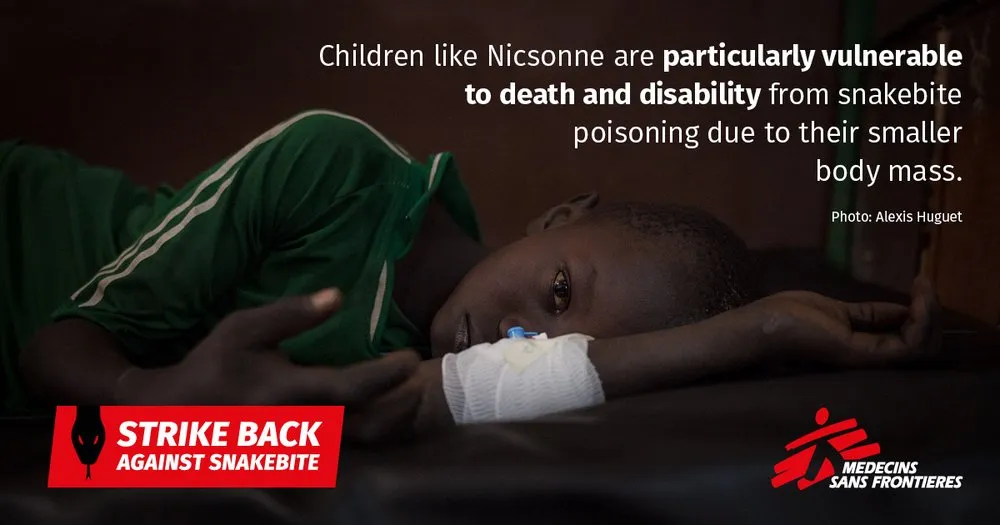
The first ten minutes are critical. Patients need close monitoring to ensure that there are no harmful reactions to antivenom.
The importance of antivenom for treating snakebite
In Abdurafi, Ethiopia, a young woman presented to our clinic with a swollen face after being bitten on the forehead while sleeping on the ground in a farm shed. Médecins Sans Frontières clinical officer Degifew Dires prepared an infusion of antivenom and spent 140 minutes slowly dripping it into the veins in her arm. “The first ten minutes are critical. The patient needs close monitoring to ensure that she has no harmful reactions to the antivenom,” says Degifew. “Over the coming hours we will regularly check her physical condition and vital signs.”
The woman was discharged after five days in the clinic, fully recovered. Not everyone bitten by a snake in Ethiopia is so fortunate, as the antivenom to treat snakebites is out of many people’s reach. “Unfortunately, in most parts of the country, effective antivenom is either unavailable or is too expensive for the communities most affected by snakebite,” says Dr Ernest Nshimiyimana.
Striking back against snakebite
Tackling snakebite is riddled with challenges, including the lack of adequate diagnostic tests for improved snake species identification, the absence of systematic training and clinical guidance for medical staff, and a poor understanding of the actual number and distribution of cases.
Prices for antivenoms vary, but often reach hundreds of dollars for the multiple doses people may need for treatment. High prices mean patients turn to more affordable antivenoms; however, some of these antivenoms are substandard, toxic or ineffective.
Médecins Sans Frontières have already begun speaking with the Australian Department of Health and Department of Foreign Affairs to urge our government to join the global fight against snakebite.
The World Health Organisation has produced a ‘road map’ to halving the number of deaths from snakebite by 2030, MSF is contributing, but we are also asking governments around the world – including Australia – to find ways to support this plan. In 2019 we hope to see the Australian government announce a significant contribution to this plan, and so really make a difference to the live of the patients struggling with the impact of snakebite.
Subscribe today and we'll send you the latest updates on our snakebite advocacy work as well as news from our projects.
Tell us your story
Australia is home to some of the world's deadliest snakes. Have you had an encounter with a snake? We want to hear from you, tell us your story.