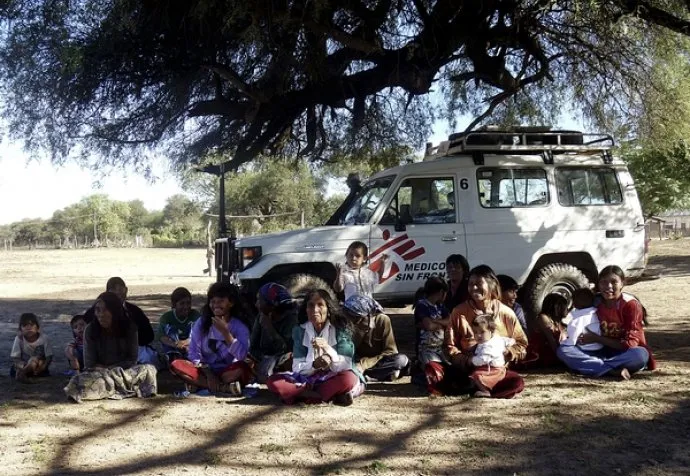
MSF worked in Argentina from 2001 until 2003.
Why were we there?
-
Providing essential medicines and supplies
Historical
Argentina's economic collapse in 2001 had severe consequences for the country's civilians. Extreme financial hardship made it difficult for many people to pay for medical care.
The public health system went from providing care to 30 percent of the population to assisting up to 70 percent (many of whom previously had been covered by private insurance). While demand in hospitals and other medical facilities increased enormously, supplies dwindled and health staff could not meet the ever-growing needs.
MSF started a project in 2002 to provide basic medical supplies and medicines to hospitals in the country's northern region – historically one of its most disadvantaged areas. MSF assisted hospitals in the Salta and Jujuy provinces and in 2003 also aided facilities in the Formosa and Chaco provinces. MSF also helped manage pharmacies until December 2003. The project concluded at the end of 2003.
In May 2003, heavy rainfall caused floods affecting more than 110,000 people living in Santa Fe province. For two months after the disaster, an MSF team provided emergency help to improve shelter and increase water and sanitation facilities. The team also monitored the area for disease outbreaks.
MSF worked in Argentina from 2001 until 2003.
OUR COVID-19 RESPONSE IN ARGENTINA
In Argentina, MSF is offering technical support and advice to a range of health authorities. This has included the design of protocols and patient flow alongside implementation of infection prevention and control measures, in health structures, alternative treatment structures, and supporting staff in aged care homes.
In Córdoba in central Argentina, MSF is providing specific technical support to the province's Emergency Operations Committee working group for enclosed structures (which includes homes for the elderly, hemodialysis units and prisons). MSF is also involved in training for staff.
In the capital Buenos Aires, MSF is collaborating with the secretariats in charge of the response to COVID-19 in the city’s vulnerable neighbourhoods. Positive case numbers are growing rapidly in these neighbourhoods, so work is underway to establish intervention strategies and priorities, and training needs for staff.
Can you make a donation to support our COVID-19 response?
Right now, Médecins Sans Frontières is providing much needed support and medical care in over 30 countries to counter the COVID-19 pandemic.
Our teams are also gearing up to confront potential outbreaks in the hundreds of areas we were already working before the pandemic struck. We are deploying medical staff, sending supplies and applying nearly 50 years of experience fighting epidemics to protect the most vulnerable and save lives.
Can you help increase our capacity to respond by making a donation to our COVID-19 Crisis Appeal?
Why were we there?
- Providing essential medicines and supplies
Our Work
- Argentina's economic collapse in 2001 had severe consequences for the country's civilians. Extreme financial hardship made it difficult for many people to pay for medical care.
- Médecins Sans Frontières started a project in 2002 to provide basic medical supplies and medicines to hospitals in the country's northern region – historically one of its most disadvantaged areas.
- Médecins Sans Frontières assisted hospitals in the Salta and Jujuy provinces and in 2003 also aided facilities in the Formosa and Chaco provinces.
- Médecins Sans Frontières helped manage pharmacies until December 2003. The project concluded at the end of 2003. In May 2003,
- Heavy rainfall caused floods affecting more than 110,000 people living in Santa Fe province. For two months after the disaster, a Médecins Sans Frontières team provided emergency help to improve shelter and increase water and sanitation facilities.
For the latest news about where we work visit: http://activityreport.msf.org/
Médecins Sans Frontières worked in Argentina from 2001 until 2003.