



A city of waiting
Mexico
Once a transit point for people travelling north to seek refuge in the US, Tapachula, capital of Mexico’s Chiapas State, has become a city of ‘forced waiting’.
Thousands of migrants – mostly from Cuba, Haiti and Honduras, and without documents, employment or access to basic services – have become stranded in the city since the US sealed its southern border in January 2025 and suspended asylum programs.
MSF has been providing essential health services to migrants living on the streets, in makeshift shelters and in informal settlements, and is offering individual and group psychological care to the migrants. The psychological impact of migration is profound and often invisible. People face grief, family separation, violence, discrimination and uncertainty.
“Many arrive with insomnia, panic attacks and a deep sense of hopelessness,” said Olga Lucia Uzcategui, MSF mental health manager. “We see patients who have lost family members along the route, who have been victims of sexual abuse, or who live in constant fear.”
In Tapachula, in southern Mexico’s Chiapas state, MSF provides medical care and consultations to migrants facing precarious conditions and limited access to basic services, 15 July 2025. © Yotibel Moreno/MSF
Filling urgent gaps
Jamaica
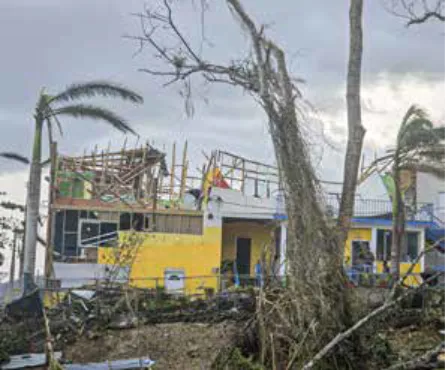
After Hurricane Melissa, a rare category 5 storm, struck Jamaica on 28 October, MSF emergency teams assessed critical needs. In remote areas, people were cut off due to road damage, and regional hospitals and healthcare centres were partially destroyed.
MSF provided medical supplies, relief items, tarpaulins and other materials, and MSF teams started working in St James Parish and in St Elisabeth Parish in the west of Jamaica. In St James parish, MSF fixed the roof and other severely damaged areas of Cornwall hospital, and restored water supply. Teams provided medical supplies to the hospital and healthcare centres, in coordination with the Ministry of Health. In St Elisabeth parish, MSF teams supported three health centres and temporary health points, providing distribution of medical supplies and logistical support, as well as trucking water to vulnerable communities.
Given the country’s robust health services and national response capacity, and the large humanitarian presence, MSF operations were less expansive than first anticipated. “We see a strong and capable system. If we fill the urgent gaps, Jamaicans can take it forward,” MSF head of mission Estifanos Mengistu told the Jamaica Information Service.
Hurricane damage in St James Parish in northwest Jamaica, November 2025. © MSF

Expanding support for healthcare
Syria
The profound consequences of Syria’s 14-year civil war include nine out of 10 Syrians now living in poverty, and 7.4 million people internally displaced.
The healthcare system, already struggling with damaged facilities, lack of medical supplies and a shortage of healthcare workers, has been heavily impacted by cuts to global funding. MSF is working in six hospitals and 15 health centres and runs several mobile clinics. “In light of the huge healthcare needs in Syria, MSF expanded activities to 11 out of 14 governorates,” said Brian Moller, head of mission for Syria. “Our main goal is to bring medical care closer to communities who may not have access to it.”
Since the fall of the Assad regime in December 2024, more than one million Syrians have returned to their areas of origin, and hundreds of thousands of refugees have crossed back from neighbouring countries. But they are returning to destroyed infrastructure and housing, and no power or clean water. The dire living conditions exacerbate the risk of infectious and waterborne diseases, and MSF teams are working to increase the availability of safe water in areas of return and in displacement camps.
A pregnant woman displaced to a shelter in Daraa governorate visited the MSF clinic in July 2025. The foetus had an irregular heartbeat, and the MSF team referred her to hospital. © Salam Daoud/MSF
Ghost towns and crowded shelters
Ukraine
As Russia’s full-scale invasion of Ukraine nears its fourth year, intensified fighting has left some communities near the front lines with little or no access to healthcare. Mass displacement has turned cities and villages into ghost towns of empty streets, damaged buildings and inaccessible healthcare.
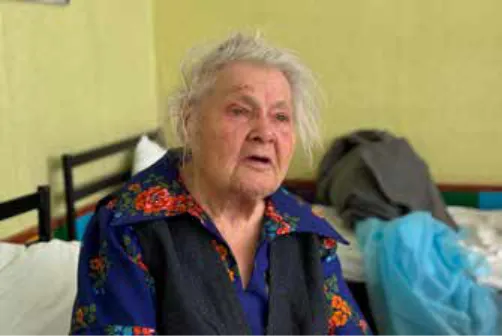
The Dnipropetrovsk region in eastern Ukraine has become a critical transit hub with overcrowded displacement shelters, where MSF mobile clinic teams have provided medical consultations and psychological support. “Most people are forced to evacuate on foot, across rough terrain under drone strikes, often through fields which may have landmines,” said Dr Ivan Afanasiev, an MSF doctor working in the shelters. “The majority of people are elderly and are already weakened by untreated chronic conditions such as hypertension, diabetes, or asthma, as well as malnutrition and anaemia.”
Oleksandra Shevchenko, 90, from Kostiantynivka, Donetsk region, moved to a shelter in Pavlohrad, Dnipropetrovsk, and waited to travel further west for treatment. © Yuliia Trofimova/MSF