
Sudan: Caring for extremely sick children
PART ONE
Dr Josephine Goodyer joined MSF’s response in North Darfur as paediatrician for Tawila Hospital in the second half of 2025, witnessing extreme suffering among people whose lives had been overturned by the ongoing war in Sudan. As Josephine describes in part one of her reflection, the gaps in the health system in the area created many challenges to meet children’s needs.
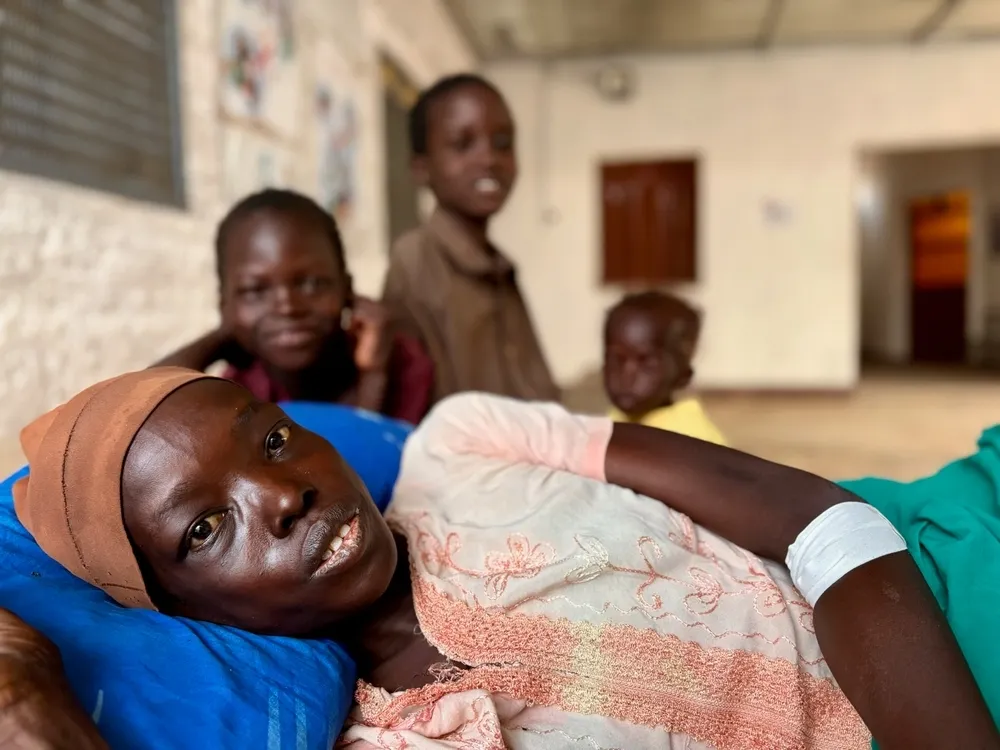

WHAT WAS YOUR ASSIGNMENT: WHAT WERE YOU BRIEFED TO DO, AND HOW DID YOU FEEL ABOUT THAT?
The context that I anticipated was huge, with overwhelming need, and the largest humanitarian crisis globally.
It was the first time I have been in that type of context, and in an emergency project. I had lots of discussion with the MSF Australia international HR team about it, and with the HR security focal point in MSF France. There was lots to read and lots to work through. I found the information confronting because there's such history behind the conflict in Sudan. It was also confronting being female, because there was lots of additional information in terms of the security assessment and the context around how gender plays a role in the security risks and in the ongoing conflict.
But mainly, I just felt that we all want to work as humanitarians where the need is greatest, and where we see and feel the greatest impact.
WHAT WAS THE SET-UP IN TAWILA THAT YOU JOINED?
I was to be one of four women: two international mobile staff and two Sudanese staff who were living with the international staff. We were housed alongside 16 men in Tawila, in relatively basic accommodation. I asked lots of information about that before I went, as I was interested to understand what the living conditions would look like.
I knew I'd have my own room; there would be shared showers, shared bathrooms; there would be no air conditioning. I knew it would be very hot, and I knew majority of the work for paediatrics was going to be severe acute malnutrition. There was a current measles epidemic. We were coming into rainy season and malaria peak season. Some of the care was going to be structured in the hospital buildings, and some of it was going to be structured in sort of what I call the paediatric tent section, which was at the gates of the main hospital.
To get to the tents it turned out you had to weave your way through some donkeys and there was an area with eight or so tents, all full of children once the physical beds were sourced.
I also knew that I was walking into a context where bed occupancy continued to be a significant challenge. When I was briefed, I think they’d been at about 150 per cent bed occupancy for children for the preceding month.

WAS TAWILA AN ESTABLISHED TOWN BEFORE THE ARRIVAL OF SO MANY DISPLACED PEOPLE? WHO ARE WE PROVIDING CARE FOR AND WHAT ARE THE LIVING CONDITIONS?
Tawila was not a displacement camp initially. We’re providing care to a host community and to a regional community which is a farming community. They choose when to come into town and in rainy season, that was a time when people do more farming and plant more crops. So we were often seeing people and children at the extremes of illness, because it would take them up to a week to travel from their farm, more often than not by foot, with malaria and seizures, and with severe acute malnutrition, to get to us.
And then Tawila itself and its surrounds are host to large, large, large, internally displaced persons camps, mainly with tent-like shelters or simple wooden constructions to create some shelter. As you drive out of Tawila, you see large numbers of people on the road by foot, but also on the back of donkeys or donkey carts, or on camels, with what looks like possessions and big bags of it, just moving.
Almost all of the Sudanese staff that I worked with were not local to Tawila and were displaced themselves. Some of them were living in relatively difficult conditions.
WHAT WERE TYPICAL DAYS, HOW WERE THEY STRUCTURED?
My day would usually start with a meeting where we'd sit down and talk to the night team, and the Sudanese staff would catch up the day team—nursing and medical staff—in terms of complicating factors, any overnight difficulty like the water supply running out or the power going out unexpectedly, and the number of admissions. And then I would join a ward round that either started with neonatology or the paediatric ICU, depending on where the sickest patients were. Usually when that had completed, I'd flip or swap and join the other [ICU round] and then I'd catch the Sudanese team members who were responsible for the different areas of the hospital for children.
I had quite limited diagnostics in Tawila, which was also information included in my briefing, and it was also the time I had zero access to imaging other than point of care ultrasound, and zero access to laboratory diagnostics. It was all point-of-care tests.
The afternoon would usually consist of reviews of the sickest patients again and some interdisciplinary teaching and education, some point of care ultrasound and then some telemedicine to obtain support for the complex cases. Through telemedicine it’s possible to consult international volunteer subspecialists including paediatric cardiologists and infectious diseases experts on MSF’s own secure internet-based platform.

WHO WERE THE SICKEST CHILDREN? YOU ALSO SAID THERE WERE EIGHT TENTS (!). HOW MANY BEDS WERE THERE PER TENT?
There was one week that I remember distinctly, because we talked about the numbers every morning before we started our working day, including the number of people admitted overnight and the number of patients in beds.
This week in particular we had about 70 children. We had been sitting at 68 admitted to ITFC [the inpatient therapeutic feeding centre, or nutrition ward] in a total of 45 beds. We had 58 children admitted to paediatrics in a total of three tents, so, another 45 beds. We had a tent for measles. And we had 11 children admitted with measles or presumptive measles overnight that night, which was a huge increase on what we'd been seeing. That had been sitting relatively stable at around four to five, and then suddenly, in the week that we were the busiest, we jumped to 11 admissions overnight.
And we also, in a seven-bed neonatal unit, had 18 babies with multiple sets of twins who can of course share a bed, which helps with the bed occupancy situation. But there were plenty of patients and the adult wards of the hospital were also significantly over-capacity.
In my time there we also had an activation of our mass casualty plan the day after we sat down and decided to simulate it, with increasing numbers of people fleeing El Fasher and making it to Tawila.
So, we had a significant amount of trauma. That was all covered by the surgical and anaesthetic international staff and their Sudanese colleagues.
As the paediatrician I also covered the paediatric trauma patients postoperatively, or simple injuries and concerns about some simple breaks.
The sickest kids were always a combination, so it wasn't ever just severe acute malnutrition. It was severe acute malnutrition and really, really, really severe cerebral malaria.
For me, the medicine is always so clinically interesting, because I found huge improvement in outcomes of children who we treated for severe acute malnutrition and cerebral malaria by improving recognition of seizure activity and clinically diagnosing status epilepticus..
The challenge with these children, and a there was a significant proportion of them, was that they remained unconscious for days, sometimes close to a week, with very short periods of clinically detectable seizure activity. I found really large differences in the improvement in their conscious level when we treated them with regular antiepileptic, anti-seizure, medication.
This article has been condensed from the original conversation and lightly edited for clarity. Read part two of Dr Goodyer’s story here.
Join our team!
Our teams of medical and non-medical professionals provide healthcare to millions of people caught in crises in more than 70 countries around the world. Learn more about working with MSF and how to apply today.
