Acknowledgement of Country

We acknowledge the Traditional Custodians of the land upon which we create and meet, the Gadigal of the Eora Nation. We pay our respect to their Elders past and present, and extend that respect to all Aboriginal and Torres Strait Islander peoples today.

Always was, always will be, Aboriginal land.

Photo Essay: Faces of MSF

Jorge Martin
Photo essay

The people who make up MSF – people who rely on our care, locally hired staff members who support their communities, and international staff who travel to projects far and wide – reflect our common humanity that knows no borders, and the difference we can make together in a divided world. 

Rebecca holds a handful of syringes
In South Sudan, Rebecca holds a handful of syringes, showing the supply of insulin she has for her 12-year-old son, Ajou, until their next hospital visit. Ajou suffers from type 1 diabetes, and each syringe is carefully used to draw insulin from vials stored in clay pots at home. © Isaac Buay/MSF
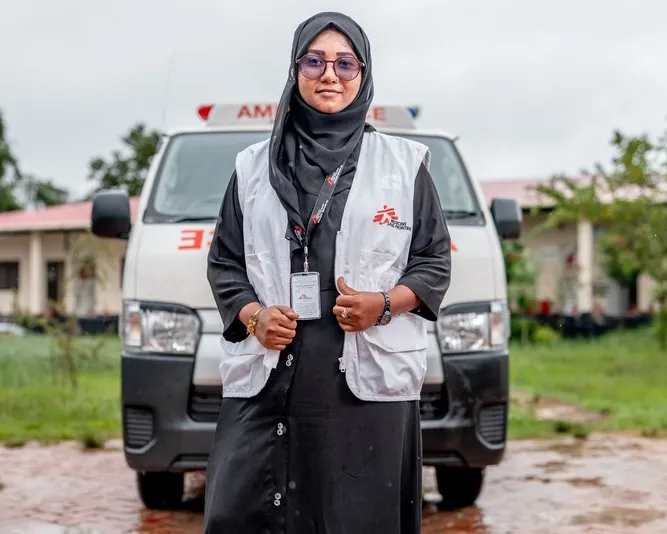
Jinnathun Nesa Jinnat
Jinnathun Nesa Jinnat, 30, is the only female driver in the MSF drivers’ team at Kutupalong refugee camp in Cox’s Bazar, Bangladesh. She is self-confident and passionate about her job. Kutupalong refugee camp, near the border of Myanmar, is the world’s largest refugee camp, with more than a million Rohingya refugees from Myanmar. © Ante Bussmann/MSF
Jorge Martín
Jorge Martín, MSF project coordinator in Mexico City, leads MSF’s effort to reshape its strategy in Mexico City following major changes in US immigration policy. As routes north become harder, migrants are transforming the city’s humanitarian landscape. © Maria Chavarria/MSF
Xilausoma, community advisor
In December 2025, MSF wrapped up its activities in northern Brazil after nearly three years providing healthcare to indigenous communities in the Yanomami territory. Xilausoma, community advisor and member of the Kalisse community, said, “For us, having MSF here in our community means a lot. MSF helped us understand malaria – how to prevent it, how to recognise the signs, and how to follow the treatment. We feel included, respected and grateful, because the team explained things in a way we could truly understand.” © Marília Gurgel/MSF
Giulia Chiopris
Giulia Chiopris, an MSF paeditrician from Italy at Tawila Hospital in North Darfur, Sudan. By late 2025, the prevalence of moderate and severe acute malnutrition among children reached alarming levels as war continued in Sudan amid global inaction. © Aurélie Lécrivain/MSF
Dr Mohamed Javid Abdelmoneim
Dr Mohamed Javid Abdelmoneim at MSF international headquarters in Geneva, Switzerland. Dr Javid, a Sudanese-Iranian emergency medicine doctor born in the UK, started as MSF’s international president in September 2025. © Pierre-Yves Bernard/MSF
Water and sanitation specialist Hamid Ullah
Water and sanitation specialist Hamid Ullah checks the water tanks at MSF’s Jamtoli primary healthcare centre at Kutupalong Refugee Camp in Bangladesh. Hamid, from the Rohingya community, has been a camp-based team member of MSF since 2023. © Ante Bussmann/MSF
Ntare Bagajo
"Nowadays even six-month-old babies are affected by kala azar,” says Ntare Bagajo, a mother from Loglogo, Kenya, whose son had kala azar, or visceral leishmaniasis, a neglected tropical disease that is almost always fatal if untreated. © Lucy Makori/MSF
HIV survivor
Sunita (name changed), an HIV survivor, gazes out from a balcony with hope for a brighter future after her regular follow-up at MSF’s advanced HIV care centre at Guru Gobind Singh Hospital, in Patna, Bihar state, India. There are limited treatment options and a high mortality rate for HIV in Bihar, as well as persistent social stigma. © Deepak Bhatia/MSF