
After more than 1,200 days of war, Sudan’s story continues to be ignored in much of the world’s media. But it is being told in the lines and language of its own people, through the work of artists who have refused to look away. At the heart of this effort is Khartoon magazine, founded in 2023 by Sudanese cartoonist Khalid Albaih.
Over the past three years, Khartoon has created a shared visual archive of a conflict marked by displacement, hunger, epidemics and the collapse of health services.
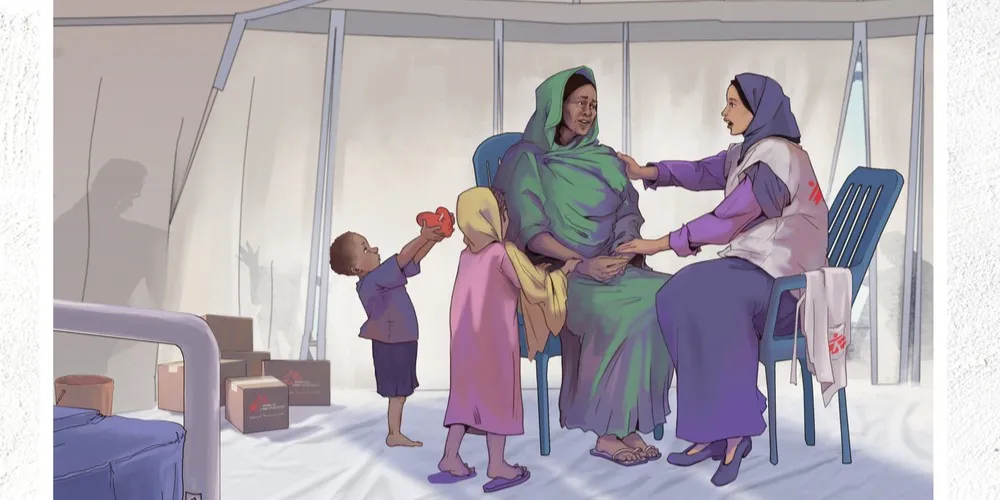
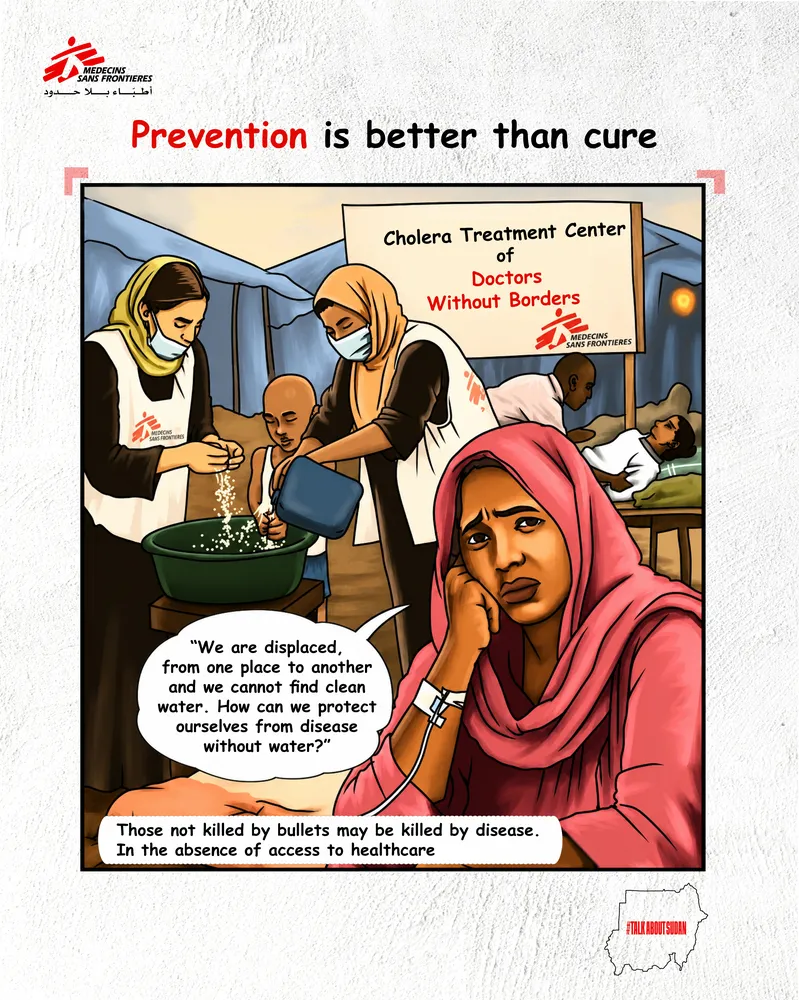
In a collaboration with MSF, Khartoon’s cartoonists have turned moments from MSF projects into images that share a humanitarian message. Among these contributors is Nader Jenni, an illustrator and writer whose work transforms suffering and data into images that anyone can understand. In this interview with The Pulse, Nader reflects on what cartooning means to him, and he shares his hopes for the future – not that drawings will stop the war, but that they will keep Sudan’s humanity visible, plant hope, and insist that the world does not turn away.
Can you tell us about the history of Khartoon?
Khartoon is an independent Sudanese magazine specialising in cartoons and comics, founded by the Sudanese artist Khalid Albaih in 2023, in the middle of the war that broke out in Sudan. It took shape from our belief that drawing is a tool for preserving memory and documenting what people are living through, especially in times of conflict.
Dozens of Sudanese artists and illustrators have contributed to Khartoon, from inside Sudan and from the diaspora. From the beginning we made it a platform open to different generations, publishing well-known names alongside young talents. We also gave particular attention to women artists and cartoonists, because we believe the documentation of war is not complete without women’s voices and the vision women bring to their own experiences and communities.
For that reason, we sought to create a safe and fair space for participation – through artist residency programs, training workshops, and the “Khartoon Qalam Talent” competition to discover new talent, as well as exhibitions and international participation. We believe Sudanese art, in all its diversity, deserves to be seen globally, and that it is best placed to express the concerns of the Sudanese zol [personality] amid this forgotten war.
What first inspired you to draw?
I started drawing in childhood, like many kids. For me it was a way of understanding the world and expressing it – and of inventing parallel worlds, which I still escape into whenever I need. I draw and I write, and over time I discovered that cartooning is the language through which I can say what is difficult to say in words. I find that drawing and writing complete one another.
What has inspired me most is the Sudanese people: starting from the circle of the family and extending to every other level. Their lightness of spirit, their ability to mock even in the hardest circumstances, and, on the other hand, the political and social contradictions we live in. It is magical realism, but brutal!
Now I make work built on old sorrows and on the memory of places that the war destroyed – and a yearning to rebuild them in the future.
Where did you grow up?
I grew up in Shajara, in the south of Khartoum, near the Nile. That environment was fundamental to who I became – the neighbourhood, the people, the markets, the neighbours’ conversations; all of it shaped my visual memory. The Nile was always present in our lives – it gave me a sense of contemplation and calm, while Khartoum, with all its contradictions, gave me endless material to think about and to draw. Now I make work built on old sorrows and on the memory of places that the war destroyed – and a yearning to rebuild them in the future.
What has your experience been over the past three years?
Exceptional years by every measure, of course. Working at a magazine that documents our daily life is not necessarily only journalistic or artistic work – it is a moral responsibility as well. We were trying to document what was happening without losing our humanity, and without losing our impartiality in directing accusations at the warring parties whenever they committed a crime against the citizens and the country; while also weighing in on the side of peace and an end to the war, and at the same time offering a visual narrative that reflects people’s daily suffering.
I learned early in my artistic path that an image can condense pages of words, and that cartooning, comics and the visual arts can be a historical document as much as they are a work of art. That is why Khartoon’s foundation is strong, and is not measured by engagement and spread on social media, but by withstanding the test of time.
We faced great challenges: the scattering of the team and the difficulty of communicating with artists inside Sudan; their fear of publishing; and the avoidance of sensitive political subjects – sometimes withdrawing work for reasons of caution and safety. Also, the challenges of funding and continuity. But against that, we built a wonderful network of artists from different generations who believe in the same idea and the same vision.
Where do you live now, and how do you stay connected to the community of Sudanese artists?
I currently live in Cairo, but I am still in almost daily contact with Sudanese artists inside and outside Sudan. The war separated us geographically, but it brought us closer professionally and as people.
Read more about the collaboration between Khartoon and MSF.