Why are we there?
- Armed conflict
- Endemic/epidemic disease
- Healthcare exclusion
Latest links
- Kenya: Humanitarian aid must be prioritised, despite return of refugees to Somalia
- Somalia: Kidnapped MSF staff released after 644 days
- Somalia: Humanitarian Aid must not be co-opted into Stabilization Campaign
Our work
This is an extract from our latest Activity Report, looking back on our work in the previous year.
2012
Despite some improvements in security during 2012, the majority of people in Somalia are still living in crisis.
Two decades of civil war have inflicted violence, displacement and loss of livelihood on the people of Somalia. Médecins Sans Frontières/Doctors Without Borders (MSF) continues to work in areas controlled by the government as well as areas held by opposition groups.
Most of the country’s healthcare infrastructure has been destroyed, leaving only one doctor in the country for every quarter of a million people.
The nutritional crisis of 2011 in south and central Somalia further damaged coping mechanisms and caused massive internal displacement as people searched for food and security.
At the beginning of the year, MSF decided to put on hold any opening of new non-emergency projects in Somalia until the safe release of its two colleagues, Blanca Thiebaut and Montserrat Serra, abducted from the Dadaab refugee camps in Kenya on 13 October 2011 and held against their will in Somalia.
Basic healthcare in the capital
Access to food, water, sanitation, health services and shelter is irregular and insufficient in Mogadishu, where an estimated 369,000 displaced people are living.
Attacks, bombs and targeted assassinations have decreased in number, but remain frequent.
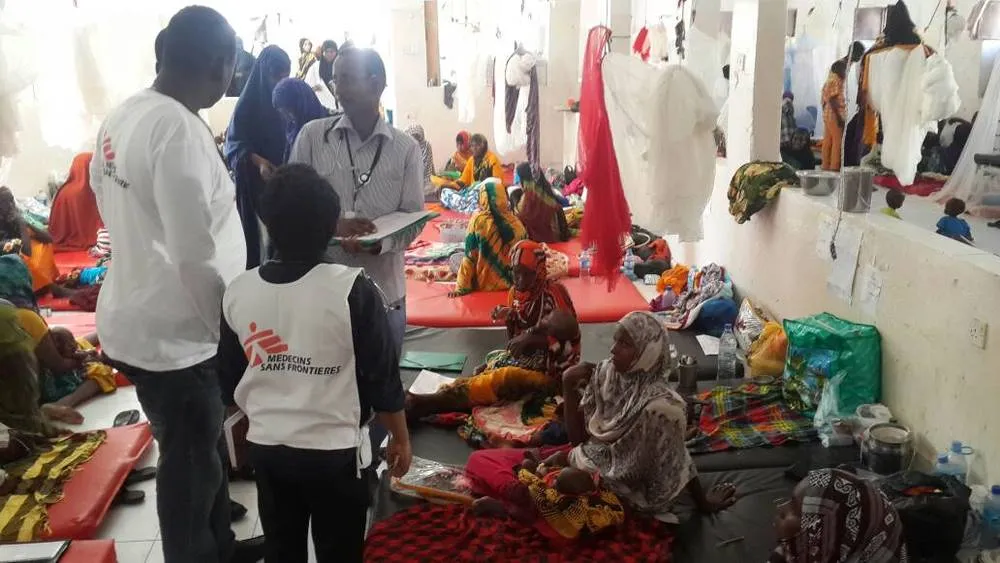
Children are suffering particularly and there is an urgent need for preventive activities such as vaccinations, as well as lifesaving emergency care. MSF supports a children’s hospital in the city, running a general ward, inpatient feeding programme and isolation units for measles and acute watery diarrhoea.
Two mobile teams travelled further afield to carry out consultations, referrals and routine vaccinations. Some 6,300 children received nutritional support, 945 were admitted for inpatient treatment and 2,480 were vaccinated against measles.
On the outskirts of the city, MSF manages 60 beds in Daynile hospital. Medical services include an emergency department, surgery, intensive care and paediatric inpatient units, a nutrition programme and maternity services.
At the end of March, fighting between pro-government forces and Al-Shabaab drove MSF to close the hospital. It was reopened in September.
Three health clinics located in Mogadishu’s Wadajir, Dharkenley and Yaaqshiid districts provide medical consultations and care for pregnant women and children to help meet the increase in need as displaced people have arrived in the areas. A mobile nutrition programme also visited six camps for the displaced in Wadajir.
Teams also ran medical clinics in the city’s Rajo, Refinery and Jasiira camps and opened two more in Howlwadaag and Xadaar in March and April, respectively.
In July and August, the clinics in Rajo, Refinery and Howlwadaag were closed. A 40-bed hospital near Jasiira camp admitted 2,000 inpatients over the year.
During a cholera outbreak in Mogadishu between May and August, teams treated 350 people for the disease.
Malnutrition in the Afgooye corridor
The Afgooye corridor, linking Mogadishu and the town of Afgooye, is an increasingly dense settlement of displaced people. MSF supports the 30-bed community hospital in Afgooye, the only health facility covering the needs of 180 villages.
The hospital offers outpatient consultations, emergency services, maternity care and an outpatient feeding programme. In 2012, staff carried out consultations with 25,640 people.
In November, MSF medical staff visited 34 camps, which host some 18,000 people. The team screened 1,530 children and treated more than 400 for malnutrition. They vaccinated children against polio, diphtheria, tetanus, measles and pertussis (whooping cough), and all children under five years of age were given albendazole, to treat worms, as well as vitamin A. Staff returned in December for follow-up.

A lab technician tests for tuberculosis at Galkayo hospital. © Siegfried Modola
Comprehensive care in Dinsor
In Bay region, MSF facilities in Dinsor offer inpatient care, a nutrition programme, maternity services, treatment for kala azar, a tuberculosis (TB) programme and outpatient services.
Mother and child programmes in Middle Shabelle
During the second half of 2012, Jowhar and Balcad were on the front line of conflict and access became a challenge for delivery of supplies and supervision visits.
MSF staff support the maternity hospital in Jowhar, and offer mother and child healthcare, including nutrition and vaccinations, through four clinics in Kulmis, Bulo Sheik, Gololey and Mahadaay. TB is also treated in Mahadaay and Gololey. MSF runs a mother and child programme at the clinic in Balcad.
Galkayo North and South
MSF has worked in the divided city of Galkayo, capital of Mudug province, for over a decade. Teams support paediatric and TB services in a clinic in Galkayo North, which is located in Puntland, a self-declared independent republic.
A new maternity ward was opened in the clinic in December. In Galkayo South, administered by the state of Galmudug, a hospital team receives patients from both sides of the regional armed conflict. Comprehensive services include emergency, maternity and paediatric care, TB treatment and surgery.
Lower Juba
MSF continues to run essential health programmes throughout Lower Juba region. In Marere, a hospital offers outpatient services, reproductive health and emergency obstetrics, surgery and TB treatment.
Mobile teams travelled to sites where displaced people had recently settled, offering basic healthcare and treatment for malnutrition. In Jilib, a health centre housing a measles isolation unit and providing cholera treatment offers services around the clock.
MSF also runs an inpatient nutrition programme for children under five in the port town of Kismayo, the capital of the region. The team opened emergency treatment units in response to outbreaks of measles and cholera during the year.
Programme closures
In May, due to worsening security conditions, MSF made the difficult decision to close its basic healthcare programmes in Dhusa Mareb and Hinder. The 108-bed hospital in Belet Weyne, Hiraan region, was closed at the end of the year. Activities in Guri El hospital, Galguduud region, will be handed back to the community in January 2013.
Healthcare in Somaliland
In the self-declared republic of Somaliland, staff are ensuring better access to healthcare and improving water and sanitation systems in Hargeisa, Mandheera and Burao (Burco) prisons. Support is also given to psychiatric patients in the Berbera mental health clinic.
An MSF team works with the Ministry of Health at Burao general hospital in the Togdheer region of Somaliland, focusing on inpatient care. In 2012, emergency staff dealt with more than 10 incidents involving the arrival of numerous casualties. When flash floods affected the region, MSF made donations to health facilities in Buhoodle.
At the end of 2012, MSF had 1,990 staff in Somalia. MSF has worked in the country since 1991.
In August 2013, after a series of violent attacks on MSF staff took place with the tacit acceptance – or active complicity – of armed groups and civilian authorities, Médecins Sans Frontières closed all of its projects in Somalia after 22 years of continuous operations. After an absence of four years, MSF started treating patients in Somalia again in 2017.
Access to food, water, sanitation, health services and shelter is irregular and insufficient. Attacks, bombs and targeted assassinations remain frequent. Children are suffering particularly and there is an urgent need for preventive activities such as vaccinations, as well as lifesaving emergency care.
Children’s healthcare
Our focus is on malnutrition and paediatric care. We support a therapeutic feeding program, outpatient and inpatient paediatric services and emergency room at the Mudug regional hospital in North Galkayo, and the maternity and paediatric wards of the regional hospital in Baidoa.

In collaboration with the Ministry of Health and other health organisations, MSF is developing a proposal on outbreak preparedness and response to support communities in southern Somalia. However, the scope of our activities depends not only on what we identify as necessary and feasible, but on the acceptance, facilitation and active support we receive from the authorities and the communities in which we work.
MSF will assess locations for future projects based on needs, feasibility and the ability to secure the presence of international staff alongside Somali staff.